Blog
What a Digital PRO Does — and What It Does Not Do

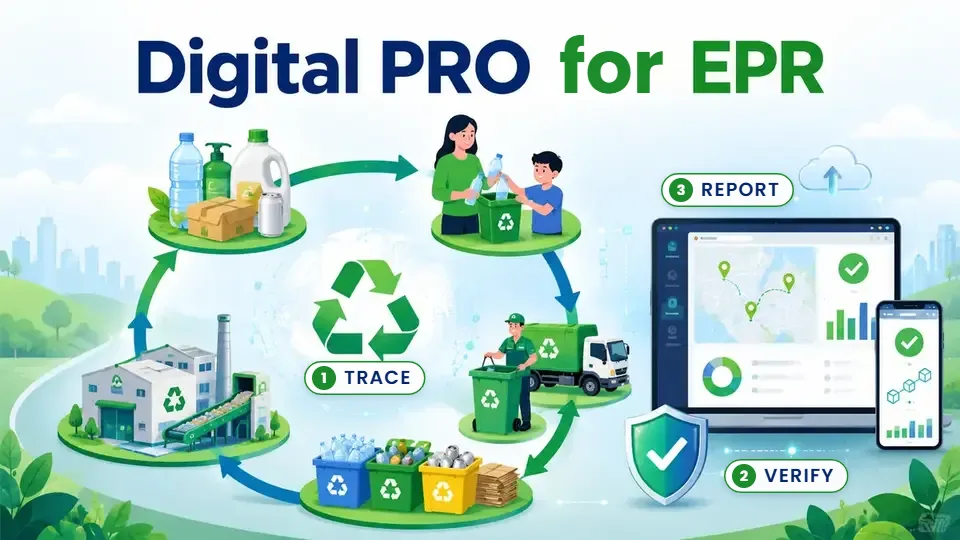
“PRO” means different things in different markets. In many European systems, a producer responsibility organisation is a scheme that takes over obligations on behalf of its members. In Vietnam, the term describes something narrower and more practical: an organisation that producers authorise to organise the recycling of their packaging. This article explains what that role covers, what the “digital” layer adds, and where its limits are — so brands, partner PROs and investors can assess any provider on the same terms.
Key takeaways
- In Vietnam’s packaging EPR system, producers and importers remain the obligated parties. Authorising an organisation is one way to carry out the recycling obligation.
- GRAC is listed on Vietnam’s National EPR Information System as a recycling organisation authorised by producers to organise recycling.
- “Digital” describes how the work is coordinated and documented: batch records, reconciled handovers and reporting packs linked to source records.
- A Digital PRO does not certify recycling, guarantee compliance or replace a legal assessment of a producer’s obligations.
Why the role needs a precise definition
Vietnam’s packaging EPR framework, now set out in Decree 110/2026/ND-CP, lets producers and importers meet their recycling obligation either by organising recycling — themselves, through recycling contractors or by authorising an organisation — or by making a financial contribution instead. The decree does not create a separate “PRO licence”. The recycling itself must be carried out by facilities that hold the environmental permits required for that activity.
For a global brand, this has two consequences. First, the producer stays accountable for the choices it makes: which packaging groups it declares, which compliance route it uses for each group, and what it reports. Second, the value of an authorised organisation lies in execution and evidence — organising collection and recycling through capable partners, and documenting the result in a way the producer can review.
Four roles in a packaging EPR programme
| Role | Typical responsibilities | What it contributes to the record |
|---|---|---|
| Producer or importer | The obligated party. Determines the packaging placed on the market, chooses a compliance route for each packaging group and signs any authorisation. | Packaging data, programme scope, the authorisation contract. |
| Authorised recycling organisation (for example, GRAC) | Plans the implementation, organises collection and recycling through partner networks within the contracted scope, and compiles documentation for the producer’s review. | Implementation plan, reconciled records, reporting packs. |
| Collectors and aggregators, including the informal sector | Recover and sort post-consumer packaging and hand it over to aggregation points or recyclers. | Source, material type, weight, handover records and photos. |
| Recycler | Receives the material and recycles it in a permitted facility, in line with the recycling specification accepted for that packaging group. | Receipt documents, weighbridge tickets, confirmation of quantities processed. |
Public authorities sit outside this chain but frame it: they maintain the National EPR Information System and review what producers declare. The authorisation contract between producer and organisation defines which tasks the organisation carries out and which documents it delivers — it is worth reading that scope closely.
What the “digital” in Digital PRO adds
Organising recycling is not new. What changes with a digital model is that each step leaves a record that can be followed and reconciled. In GRAC’s case, implementation is coordinated on a data platform that links transactions, quantities and documents across the parties involved:
- Batch and transaction records from the point of collection, including source, material type, weight, time and location.
- Handover reconciliation: the quantity dispatched by one party is compared with the quantity received by the next, so any discrepancy is isolated to a specific handover.
- Separation of collection data from recycling confirmation: recycling results rely on the receiving facility’s confirmation and documents, not on collection figures.
- Reports compiled by reporting period, with references back to the underlying transactions and a list of documents still missing.
- Review support: records showing signs of duplication, discrepancies or missing links are flagged for human review before documentation is finalised.
The method behind these records is explained in Collected ≠ Recycled: Building Reconcilable Recycling Evidence. For the platform itself, see Digital PRO & Material Traceability.
What a Digital PRO does not do
- It does not certify recycling. Recycling results depend on the recycler’s confirmation and supporting documents. Where a programme requires independent assurance, that is arranged separately; well-kept records make such a review easier, but they do not replace it.
- It does not guarantee EPR compliance. Software supports data and evidence management. It does not replace the assessment of legal obligations, checks on participant eligibility or the review of supporting documents.
- It does not take over the producer’s decisions. Classifying packaging, choosing a compliance route for each group and submitting declarations remain the producer’s responsibility, supported by the information the organisation provides.
- It does not turn collection into recycling. Collected, received and confirmed-recycled quantities are different numbers and are reported as such.
- It does not make the same tonne count twice. Recycling results used for one obligation should not be declared again elsewhere; records are kept per programme so that this can be checked.
How to check an organisation’s status
Status can be checked publicly. On the National EPR Information System (epr.mae.gov.vn, in Vietnamese), open the published list of organisations authorised by producers to organise recycling and search for the company name or tax ID. GRAC is listed as Công ty Cổ phần Công nghệ GRAC (GRAC Technology JSC), tax ID 0317005247.
A listing confirms status, not performance. Before authorising any organisation, ask to see sample records and the documents you would receive for a reporting period.
Questions to ask before you authorise an organisation
- Which recyclers will process my material, and do they hold the permits required for that activity?
- How are collected, received and confirmed-recycled quantities tracked and reported separately?
- Which documents will I receive for each reporting period, and in what format?
- How are discrepancies, missing documents and suspected duplicates handled — and who reviews them?
- Can you work with my existing recyclers or collection network?
- Which tasks remain with my team, and which are covered by the authorisation contract?
Where GRAC fits
GRAC works with producers and brands to coordinate collection and recycling through partner networks, trace material batches and prepare supporting records for review. Materials, quantities, geography and outputs are agreed in each project contract. To estimate the financial side of your obligation first, try the 2026 Packaging EPR Cost Calculator.
Discuss your packaging EPR programme
Share your packaging scope and existing partners. We will propose an implementation approach and the records you would receive.
This article provides general information about Vietnam’s packaging EPR framework and is not legal advice. Obligations depend on each organisation’s products, packaging and circumstances. Last reviewed: 16 October 2026.

