Digital PRO · Packaging EPR · Material traceability
A digital EPR platform. From collection to recycling evidence.
GRAC combines EPR implementation with material traceability, helping organisations follow material batches, reconcile handovers and connect supporting records from source to recycler.
GRAC Digital PRO · Trace · Verify · Report
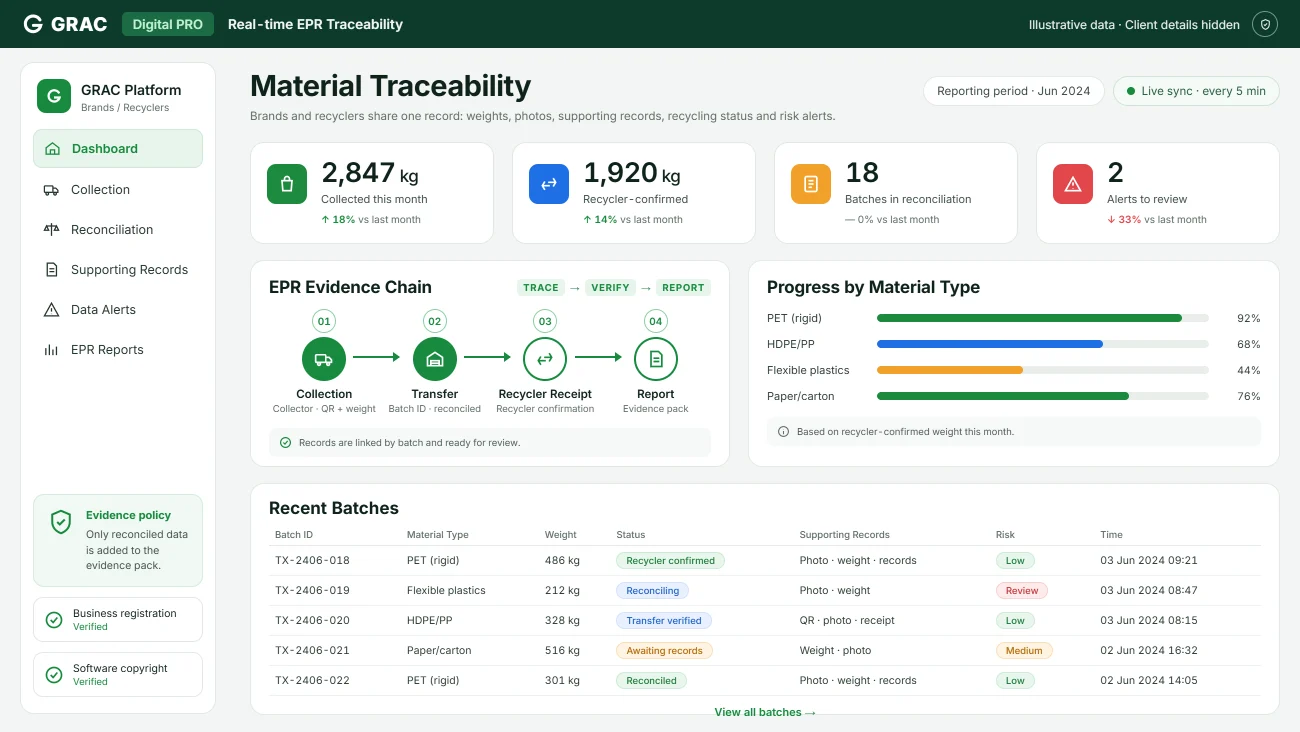
Figures reported by GRAC. Traced volumes are not the same as confirmed recycling results for a specific EPR obligation.
01 / The problem
EPR needs more than a final tonnage.
It needs reconcilable records.
A period-end total does not show where material originated, how it moved between participants, how much a recycler received or which records support the reported result.
GRAC connects these steps through a shared data layer so participating organisations can review the same chain of information.
Fragmented records
Collection, handover, weighing and receipt information often sits across different organisations and document types.
Batch continuity
When material from multiple sources is aggregated, the link between source transactions and transferred batches needs to remain visible.
Discrepancies need context
Quantities recorded by the sender and confirmed by the receiver may differ and should be isolated to the relevant handover.
Collection is not recycling
Collected quantities, recycler receipts and recycling results should be managed as separate states.
02 / Digital PRO
One point of coordination.
One data chain to reconcile.
GRAC works with organisations based on the agreed materials, quantities, geography and required outputs under the project or contract.
- 01
Planning
Review packaging data, material categories and quantities and define the implementation approach.
- 02
Coordination
Coordinate collection and recycling through participating partners within the agreed scope.
- 03
Documentation
Reconcile quantities, link supporting records and compile information by reporting period.
- Implementation approach
- Quantity data by status
- Reconciliation tables
- Supporting documentation agreed under the contract
Collected quantities, recycler receipts and confirmed recycling results are tracked separately. Which results can be used for EPR reporting should be reviewed against the corresponding documentation.
03 / Material traceability platform
Track material by batch.
Reconcile every handover.
For brands, collection facilities, recyclers and programme managers. GRAC links transactions, quantities and supporting records across participants and can be deployed on an existing collection and recycling network.
Data at each stage GRAC / Traceability
Stage 01 · Source & Collection
Every material flow has a starting point.
Material quantity is linked to the collection transaction and originating source from the beginning.
- Identification
- Waste/material source · Material type · Transaction ID
- Collection
- Time · Location · Collector
- Quantity
- Recorded quantity · Weighing information
- Evidence
- Photos · Weighing records · Related documents
Establish the origin before aggregating the data.
Stage 02 · Transfer & Aggregation
Follow every handover.
Each transfer reconciles the quantity recorded by the sender with the quantity confirmed by the receiver.
- Linkage
- Batch reference · Related collection transactions
- Parties
- Sender · Receiver · Aggregation point
- Reconciliation
- Quantity dispatched · Quantity received · Discrepancy
- Evidence
- Receipts · Weighbridge tickets · Handover photos
Discrepancies are isolated to the specific handover.
Stage 03 · Recycler Receipt
Separate collection from recycling.
Recycler receipt data and supporting records are managed separately from collection records.
- Facility
- Receiving facility · Material batch
- Input
- Quantity · Material type · Date received
- Reconciliation
- Figures confirmed by the receiving party
- Evidence
- Receipt documents · Recycler confirmation
Collection ≠ confirmed recycling.
Stage 04 · Reconciliation & Reporting
Reports stay connected to their underlying records.
Missing information, discrepancies and suspected duplicate records are placed into review before the reporting dataset is finalised.
- Scope
- Reporting period · Material · Geography · Programme
- Summary
- Quantities by reconciliation status
- References
- Transactions · Batches · Supporting records
- Follow-up
- Missing data or documentation
Reported figures can be traced back to the underlying transaction and source record.
What you receive: Batch and transaction records · Reconciliation tables · List of outstanding documents · Periodic reports.
Programme applications include post-consumer material traceability and reconciliation of recycled-material origin. The data and evidence scope is agreed for each programme.
Request a Traceability Demo04 / How the data works
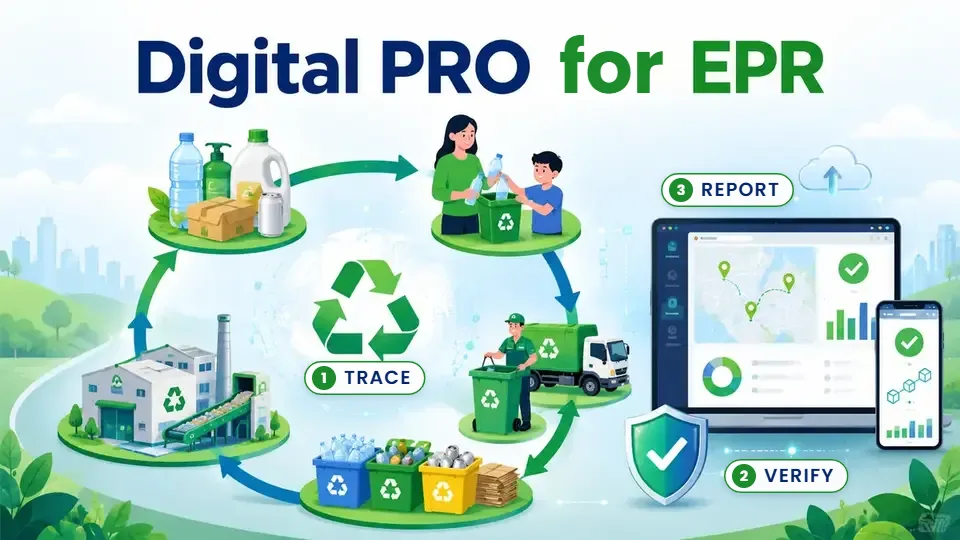
Trace → Verify → Report
Three layers of data handling, from the first record to the reporting-period dataset.
Trace
Connect
- Material source
- Collection transaction
- Batch
- Handover
- Recycler receipt
Verify
Reconcile
- Dispatched vs received quantities
- Transaction-to-batch linkage
- Supporting records
- Missing data
- Discrepancies
- Potential duplicates requiring review
Report
Compile
- Period-based datasets
- Quantities by status
- Reconciliation tables
- Supporting references
- Outstanding items
“Verify” refers to data and document reconciliation within the agreed programme scope. It does not mean automatic legal certification of an EPR result.
05 / Data & supporting records
Know what each reported result is based on.
The required evidence set depends on the programme, contract and reporting requirements.
Transaction ID
Links each recorded transaction to its source and timestamp.
Quantity
Weighing information or recorded quantities from the relevant stages.
Photos
Field or handover images where required by the programme.
Weighbridge / receipt records
Supporting documents for transfers and material receipt.
Recycler confirmation
Receipt or confirmation information provided by the receiving facility within the agreed scope.
Commercial documents
Contracts, invoices or related records where relevant to the agreed reconciliation process.
06 / How to work with GRAC
Need implementation support,
or only the traceability layer?
Choose either model, or combine them programme by programme.
Digital PRO · EPR implementation
GRAC coordinates implementation.
For organisations that need GRAC to coordinate collection and recycling activities and compile supporting documentation within an agreed project scope.
You receive- Implementation approach
- Network coordination
- Progress data
- Reconciliation
- Supporting records
Platform · Material traceability
A data layer on your own network.
For organisations that already have collectors or recyclers and need a data layer for material tracking, handover reconciliation and record management.
You receive- Configured data scope
- Transaction and batch records
- Reconciliation tables
- Outstanding-data list
- Periodic reports
07 / Who it is for
One data layer.
Multiple participants.
Each participant records or confirms its own part of the data, within the agreed scope.
Producers, importers & brands
Track progress, quantities by status and supporting documentation for EPR or material-recovery programmes.
Collectors & aggregation facilities
Record transactions, batches, handovers and field documentation within the agreed scope.
Recyclers
Record or confirm receipt data, quantities and related documents.
Programme managers
Reconcile information across participants and compile reporting-period datasets.
08 / Existing infrastructure
Not starting from an empty dashboard.
GRAC already operates systems for waste-generator management, collector networks and material-recovery programmes. The traceability platform can connect with this data infrastructure or be deployed on a client’s existing collection and recycling network.
Clients do not need to adopt the entire GRAC ecosystem. Integration scope is defined programme by programme.
Waste-generator management
270+ commune-level local authorities using GRAC services · 1M+ waste generators managed in the system.
Municipal waste management softwareCollector network
1,200+ people and collection entities connected, including the informal sector.
Material-recovery programmes
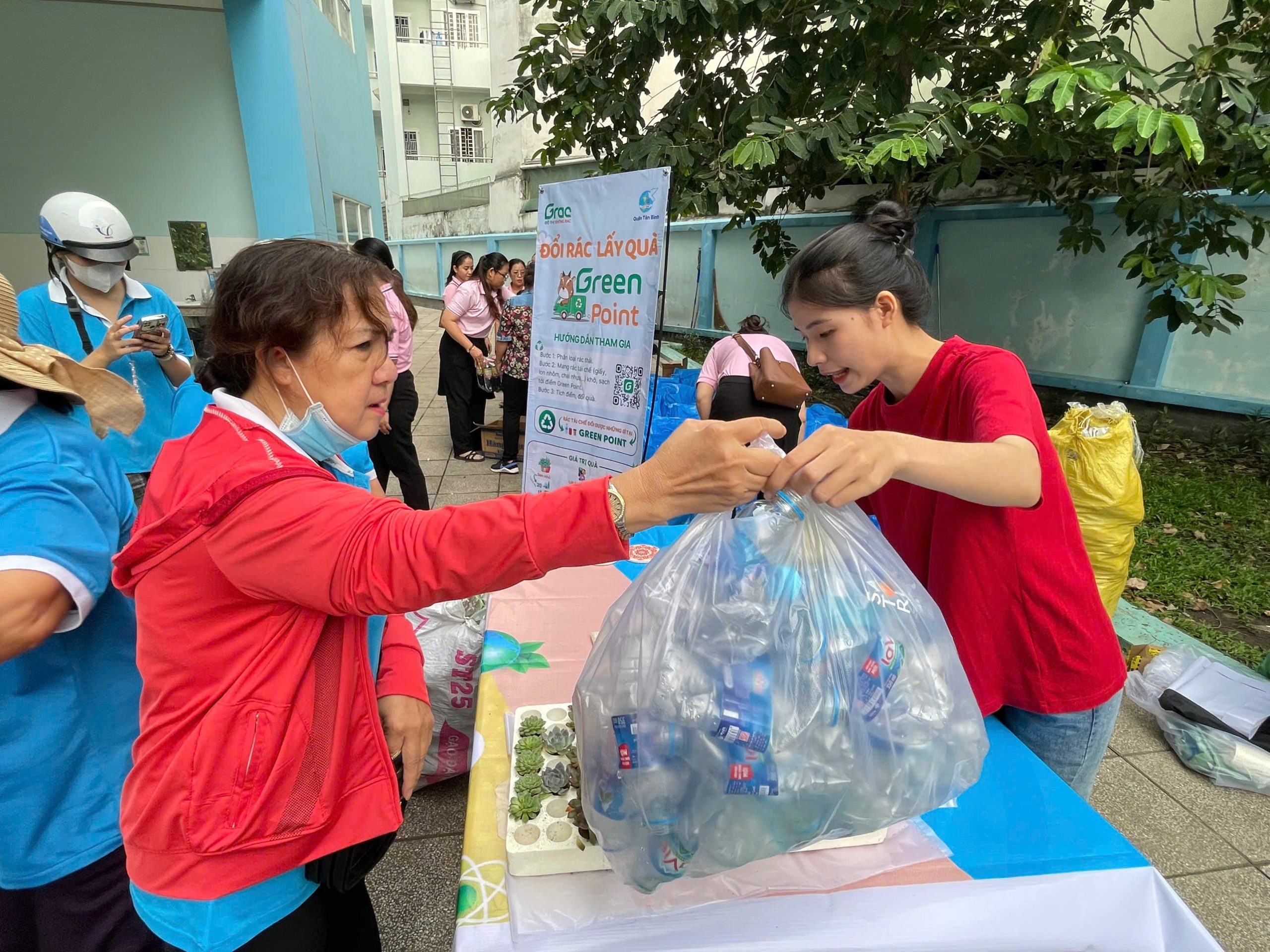
Example: the Tan My Ward Material Recovery Station, Ho Chi Minh City.
See GRAC’s role
09 / Verifiable capability
Digital infrastructure backed by field implementation.
Public information from regulators, partners and certification bodies. Company-specific EPR data remains confidential under contract.
EPR
Vietnam’s National EPR Information System
GRAC is publicly listed as an organisation authorised by producers to organise the recycling of products and packaging.
Verify at epr.mae.gov.vn VietnameseManagement systems
ISO 9001 · ISO 14001
- ISO 9001:2015
- ISO 14001:2015
Digital capability
Intellectual property
- Software copyright No. 1139/2024/QTG
- GRAC trademark protected in Vietnam
Field implementation
Tan My Material Recovery Station
- Station management
- People’s Committee of Tan My Ward
- Funding
- Unilever Vietnam
- Construction, traceability & transfer to recycler
- GRAC
10 / FAQ
Frequently asked questions
Clarity on roles, data and scope from the outset.
Does the GRAC platform automatically guarantee EPR compliance?
No. The platform supports data management, reconciliation and supporting records. Legal obligations, participant eligibility and whether a result can be used for a particular EPR report still need to be reviewed against the applicable requirements and documentation.
Can GRAC work with our existing recycler or collection network?
Yes. The platform can be deployed on an existing network. The parties first agree the required data, documents, handover points and reporting outputs.
What is the difference between Digital PRO and using the traceability platform?
Digital PRO includes implementation coordination within an agreed project scope. The traceability platform is the data layer used to record, reconcile and report material flows. It can also be used where the client manages its own collection and recycling network.
Does collection automatically count as recycling?
No. Collected quantity, recycler receipt and confirmed recycling results are tracked separately. How a result is used depends on the corresponding data and supporting documentation.
Does every transaction require a QR code?
Not necessarily. Depending on the programme design, records may use transaction IDs, QR codes, photographs, weighing information or other supporting documentation.
Does the platform detect duplicate records?
The platform can support review of transactions or datasets showing potential duplication, discrepancies or missing linkages. These cases are placed into review; the platform does not replace checks and confirmation by the parties involved.
Start with GRAC
Define the scope first.
Configure the platform second.
Tell us the material, existing network and data outputs you need. GRAC will propose an implementation scope around those requirements.
- 01Understand the requirementsOutput: scope and input data
- 02Agree the operating modelOutput: implementation approach and participant responsibilities
- 03Deploy & reconcileOutput: configured system and agreed dataset
Which solution do you need?
Talk to GRACShare your requirements to receive a proposed implementation scope. About GRAC

