
Blog
Collected ≠ Recycled: Building Reconcilable Recycling Evidence

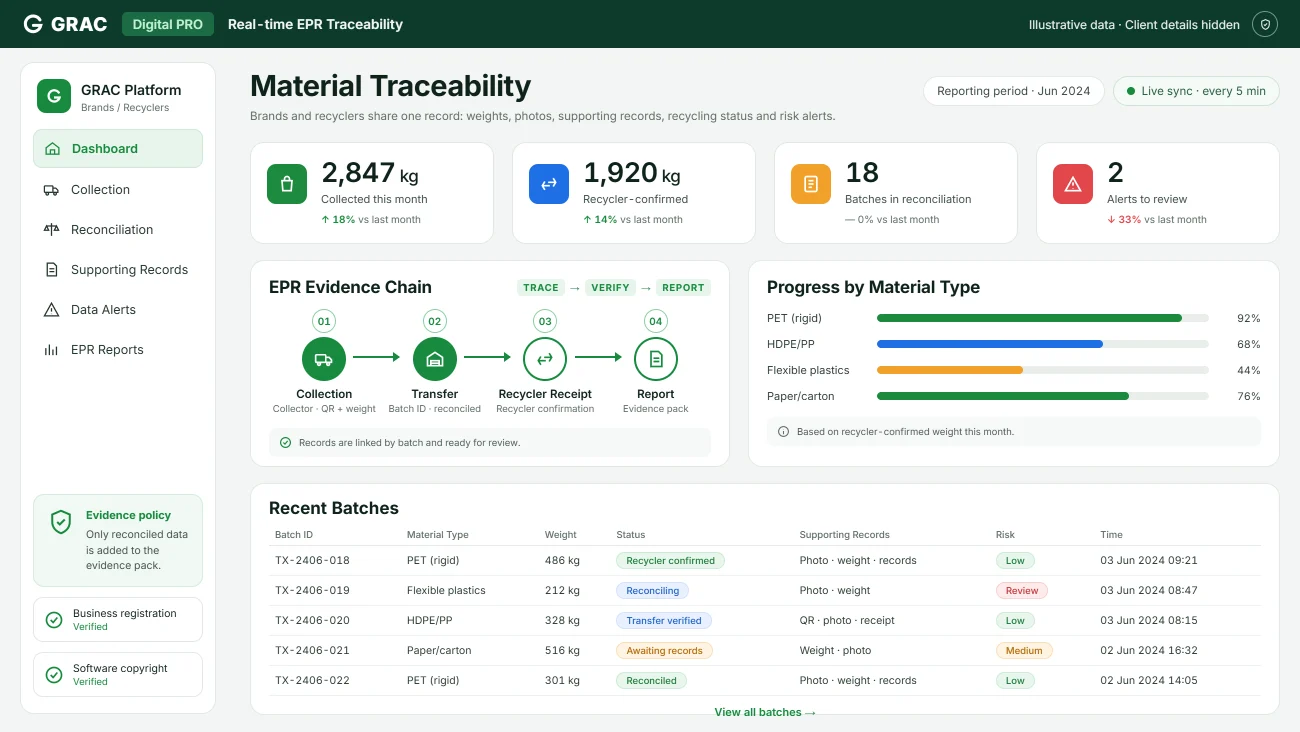
A tonne collected is not a tonne recycled. Between the street and the recycling line, material is sorted, weighed, moved, rejected and processed — and each step changes the number. Packaging EPR programmes that treat these figures as one quantity create a gap between what is reported and what can be supported. This article explains the three numbers that matter, the rules that shape the evidence, and the Trace → Reconcile → Report method GRAC uses to keep them apart.
Key takeaways
- Collected, received by the recycler and confirmed recycled are three different quantities. Report each one, not a single figure.
- Only confirmed recycling can support a recycling result for an EPR obligation — and only if the material and process meet the eligibility rules.
- Reconciliation links every reported figure to the transactions and documents behind it, and makes gaps visible early.
- Reconciled records support review and independent assurance; they do not replace them.
Three numbers that are often confused
| Collected | Received by the recycler | Confirmed recycled | |
|---|---|---|---|
| What it measures | Material recovered from a source and recorded at collection or aggregation | Material accepted by the receiving facility | Material the facility confirms it processed under the recycling specification accepted for that packaging group |
| Typical evidence | Collection transaction, source, material type, weight, photos | Receipt documents, weighbridge tickets, recycler acknowledgement | Processing records and the facility’s confirmation for the period |
| Why it changes | Moisture, contamination, sorting losses | Rejections at intake, transport losses | Process yield, material outside the accepted specification |
The figures shrink from left to right, and that is normal. The problem arises when a report presents the first number with the meaning of the third.
The rules that shape the evidence
Under Vietnam’s packaging EPR framework (Decree 110/2026/ND-CP), recycling results counted towards an obligation have to meet conditions on both the material and the process. In practice, the evidence must be able to show that:
- the material is post-consumer — not imported scrap, industrial scrap or production rejects;
- it is tracked separately and its origin is documented;
- the same quantity is not declared twice, whether for another producer or another programme;
- the process matches the recycling specification accepted for that packaging group. For flexible plastic packaging (group A.3.4), for example, co-processing in cement kilns, energy recovery and use as alternative fuel do not count towards the recycling rate.
These conditions are why the record has to follow the material from its source, not start at the recycler’s gate.
Trace → Reconcile → Report
1. Trace: record each stage at the point it happens
- Source and collection — waste source, material type, transaction ID, time, location, collector, recorded quantity and weighing information, photos.
- Transfer and aggregation — batch reference, sender, receiver, aggregation point, and the related collection transactions.
- Recycler receipt — receiving facility, material batch, quantity and date received, receipt documents.
Origin is established before any figures are aggregated, so every later number has a starting point.
2. Reconcile: compare what was sent with what was received
- At each handover, the quantity dispatched is compared with the quantity received; any discrepancy is isolated to that handover.
- Recycler receipts are matched to the batches they relate to.
- Collection data is kept separate from recycling confirmation, which relies on the receiving facility’s documents.
- Missing data, discrepancies and suspected duplicates are flagged for human review before documentation is finalised.
3. Report: compile by period, with the records attached
Reports are compiled by reporting period, material, geography and programme. They show quantities by reconciliation status, reference the underlying transactions and documents, and list what is still missing. Every reported figure can be traced back to its source records.
An illustration
Hypothetical example — illustrative figures, not GRAC programme data. A programme records 100 tonnes collected in a quarter. Recyclers acknowledge receipt of 92 tonnes; the difference is traced to two handovers with documented rejections and moisture losses. Recyclers confirm 85 tonnes processed under the accepted specification. A reconciled report shows all three figures, explains each gap with references, and makes clear that only the 85 tonnes are candidates for a recycling result — subject to the eligibility checks above.
What reconciliation can and cannot tell you
Reconciliation shows whether quantities are consistent across handovers, where gaps sit and which documents support which figure. It cannot replace the recycler’s confirmation, and it is not independent verification. Where a programme or a regulator requires an independent audit or third-party assurance, that review is arranged separately — and reconciled records are the input it works from.
Checklist: documents to request from a recycling partner
- Facility identity and the environmental permit covering the recycling activity.
- Receipt documents or weighbridge tickets for each delivery, with a batch reference.
- Confirmation of the quantity processed in each period and the process used.
- A statement on material origin (post-consumer) and how rejects are handled.
- Confirmation that the same quantity is not declared to another programme.
How GRAC applies this
GRAC’s traceability platform is deployed on existing collection and recycling networks, within a data scope agreed for each programme. It produces batch and transaction records, reconciliation tables, a list of documents still required and periodic reports. For the roles behind the records, read What a Digital PRO Does — and What It Does Not Do.
Make your recycling figures reconcilable
Tell us which materials, partners and reporting periods you need to cover. We will show how the records would look for your programme.
This article provides general information and is not legal advice. Eligibility of recycling results depends on the applicable regulation, the packaging group and the documents available. Last reviewed: 16 October 2026.

