Blog
What International Institutions and Media Say About GRAC

This overview of GRAC in international media brings together third-party evidence from development institutions, corporate programmes and independent publications.
GRAC Technology is a Vietnamese climate-tech company developing digital infrastructure for waste management, Extended Producer Responsibility (EPR), and waste traceability.
Over the past few years, GRAC has appeared in research, innovation programmes, corporate sustainability disclosures and English-language media from organisations including the World Bank, Asian Development Bank (ADB), UNDP, ERIA, CSIRO, Climate Finance Accelerator, JETRO and PepsiCo Global.
The important question is not how often GRAC has been mentioned. It is how independent institutions, research organisations, global corporations and media describe GRAC in the context of digital waste management, circular economy infrastructure, EPR and material traceability.
1. World Bank: GRAC in the broader picture of EPR and digital waste management
In its Extended Producer Responsibility — Assessment Findings, the World Bank refers directly to GRAC within its assessment of EPR and waste-management systems in Vietnam. The report notes functions related to waste traceability, waste-classification guidance and online payment services.
According to historical data used in the study, GRAC at that time served approximately 600,000 households and 30,000 waste generators. This matters because the platform is considered within a broader policy assessment, not merely a startup profile.
2. Asian Development Bank: GRAC identified as a solution with scale-up potential
GRAC has appeared in ADB research and innovation initiatives over several years. In a study examining digital solutions for plastic waste management in Vietnam, GRAC, mGreen and VECA were identified among solutions with strong potential for further development and scale-up.
From assessment to pilot
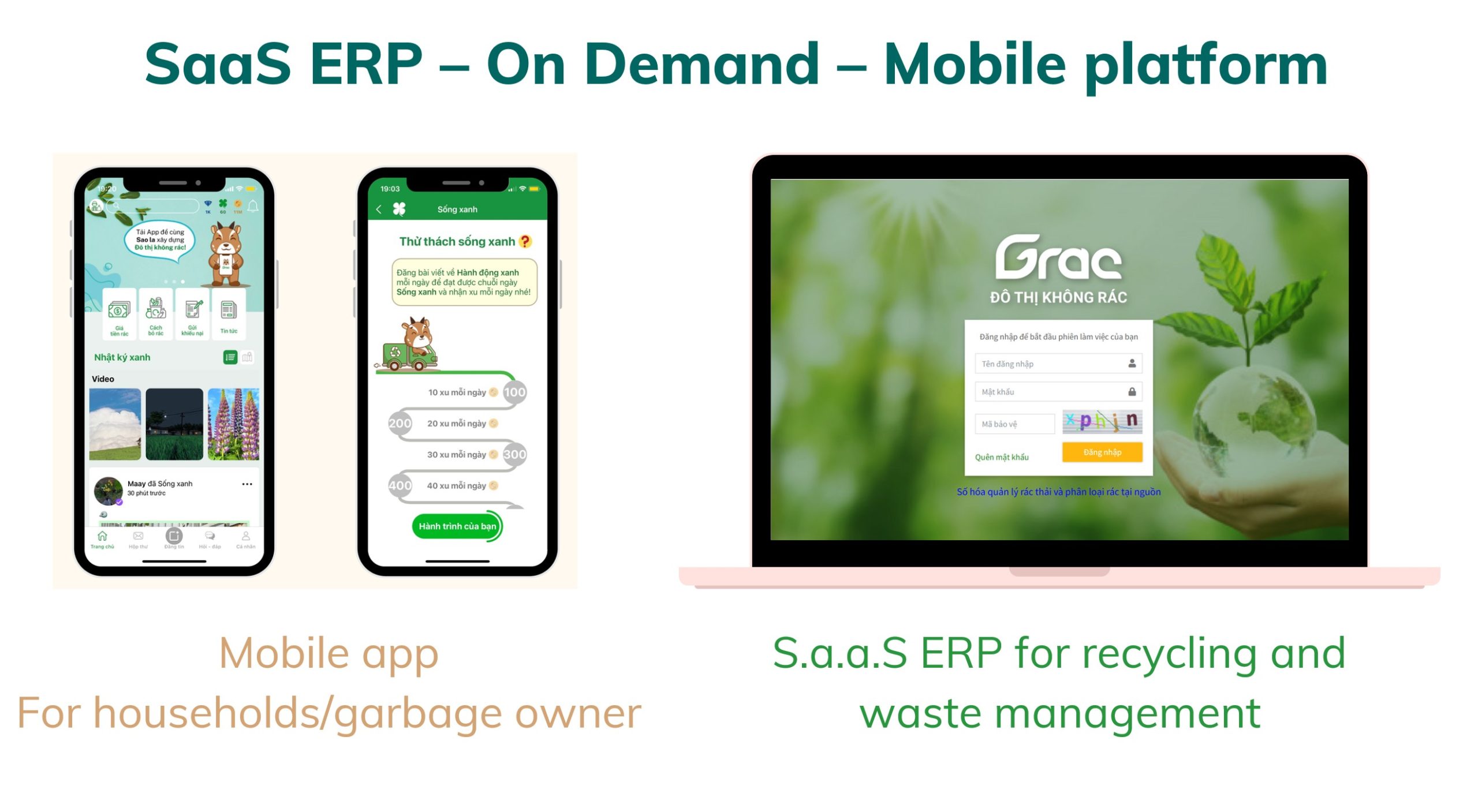
Under Digital Innovation for Plastics Circularity: Lessons from Indonesia and Viet Nam, ADB tested digital solutions including GRAC. ADB describes GRAC as a web and mobile system for municipal waste services and an online recycling marketplace. The work looks beyond technical feasibility to effectiveness, scalability, sustainability and inclusivity.
3. UNDP: GRAC in the map of digital operators in Vietnam’s recycling sector
UNDP dedicates a section to GRAC in its work on a digital marketplace for Vietnam’s plastic recycling sector. The study places GRAC in a broader discussion of how digital infrastructure can support a functioning recycling marketplace.
UNDP later included GRAC in Viet Nam’s Plastic Innovation Shift 2020–2025, where it appears among SaaS waste-management platforms and collection-point models. Read the underlying UNDP marketplace study.
4. ERIA: “GRAC, a pioneering climate-tech company”
In April 2025, the Regional Knowledge Centre for Marine Plastic Debris under ERIA published GRAC: Leading the Charge in Sustainable Waste Management, describing GRAC as a “pioneering climate-tech company”.
The article discusses digital waste management, traceability, Green Points, community engagement and circular-economy models. It also notes that GRAC had 10 operational Green Points in Vietnam by the first quarter of 2025.
5. Climate Finance Accelerator: from waste-tech to climate investment
The Climate Finance Accelerator describes GRAC as a digital waste-management and traceability platform that tracks post-consumer packaging and supports EPR compliance.
GRAC is positioned within Waste & Circular Economy and in an investment context involving platform R&D, corporate pilots, EPR traceability infrastructure, working capital and commercialisation in Vietnam and ASEAN. This is a useful illustration of how reliable material data can support EPR, ESG, impact measurement and climate finance.
6. CSIRO and IPPIN: GRAC in the Indo-Pacific plastics innovation ecosystem
GRAC also appears in the Indo-Pacific Plastics Innovation Network ecosystem led by CSIRO, Australia’s national science agency. In the Vietnam cohort, GreenTeam is introduced as a specialised unit of GRAC Technology JSC.
The solution focuses on digitising junkshops and aggregators while connecting Informal Waste Workers → Junkshops / Aggregators → Recyclers. The Vietnam IPPIN cohort shows why data needs to move with physical material in fragmented recycling systems.
7. JETRO: GRAC on Japan’s J-Bridge platform
JETRO has a company profile for GRAC on J-Bridge. The profile highlights Municipal Waste Traceability, an EPR Platform for Recyclables Traceability and EPR Fulfillment Services.
It describes a system following recyclable materials through Generation → Collection → Aggregation → Recycling, linking physical flows with material source, weight, timestamps, counterparties, supporting documentation and recycling evidence. A company profile should be read as a business-matching record, rather than as independent endorsement of every claim it contains.
8. PepsiCo Global: a dedicated “GRAC Program”
One of the strongest corporate references appears on PepsiCo’s global ESG packaging page, where a section is titled “GRAC Program”.
PepsiCo states that Vietnam Foods completed Phase 1 of Green Points with GRAC, reaching more than 5,000 people and collecting 19 tonnes of recyclable materials. It also notes continued expansion in 2026. The progression is notable: Accelerator → Pilot → Field Implementation → Global Corporate ESG Disclosure.
9. Media coverage: GRAC increasingly described as a business, not only an environmental project
In December 2025, VnExpress published a business article examining GRAC’s commercial model, including an annual service fee of approximately USD 3,500 per institutional customer and the company’s reported operating scale.
Tan My MRF: when digital technology moves into the material flow
Vietnam News described the use of standardised, transparent data across the Sorting → Collection → Recycling chain at the Tan My material-recovery facility. The use case is important: technology is not only a dashboard; it follows physical material in the field.
From innovation recognition to implementation
VnEconomy English covered GRAC in the context of plastic-circularity innovation and later field implementation with Unilever and local government. A precise formulation is that GRAC provides the technology platform behind an award-winning digitally enabled MRF model; this does not mean GRAC itself received a partner’s award.
10. What are external organisations actually seeing in GRAC?
Stage 1 — Waste-tech
Digital waste management, household and waste-generator databases, waste collection and municipal operations.
Stage 2 — Circular Economy Infrastructure
Plastic collection, Green Points, informal-sector inclusion, recycling marketplaces and data infrastructure.
Stage 3 — EPR Infrastructure
Post-consumer packaging, material traceability, recycling evidence, producer compliance and EPR fulfilment.
Stage 4 — Material Traceability
Waste Source → Collector → Aggregator / Transfer Point → Recycler
Running alongside the physical flow is a data flow: Material → Weight → Timestamp → Sender / Receiver → Evidence → Reconciliation.
11. From Waste Management to Global Waste Traceability
GRAC began with a simple question: who generates waste, who collects it and how is the service managed? As EPR, recycled-content requirements and circularity claims develop, the question becomes where the material came from, who collected it, how many kilograms were transferred, who received it, which recycler processed it and what evidence proves that recycling occurred.
Municipal Waste Digitalisation → Recycling Traceability → EPR Infrastructure → Global Waste Traceability
GRAC in Vietnamese media
For implementation, adoption and operating evidence in Vietnam, read how Vietnamese media and public institutions have covered GRAC.
Learn more about GRAC
Explore GRAC’s company profile, the GRAC platform and its waste-traceability approach in Vietnam.